🎉 Welcome to TECHBUILDERS! Stay tuned for updates and announcements. 🚀

The Future Is Adaptive, Human, and Emotionally Intelligent The design industry never stands still — and by the end of 2025, we’re witnessing a massive shift in how we experience digital products. It’s no longer about perfect pixels or minimal layouts; it’s about how users feel, interact, and connect with the product on a deeper level. Let’s explore the UI/UX trends that are defining the close of 2025 — and shaping the foundation of the years ahead.
2025 marks the death of “one-size-fits-all” design. Modern products are built for adaptivity — not just in screen size, but in behavior, emotion, and context. Instead of creating fixed templates, designers now build systems that automatically adjust based on user data, interaction patterns, and even time of day. For example: A banking app might simplify its interface when it detects frequent errors by a user. A fitness dashboard could shift to darker, calmer tones during late-night sessions. Adaptive UI isn’t just responsive — it’s aware.
By late 2025, AI has officially become the designer’s assistant, not the replacement. Designers now collaborate with AI to explore variations, generate concepts, and test flows. But the magic lies in human direction — the emotional sense, storytelling, and empathy that no AI can replicate. Think of AI as your intern: fast, eager, sometimes wrong — but incredibly useful when guided properly. The winning formula? Designers who merge AI efficiency with human intuition.
Interfaces are learning to feel human again. We’re seeing more products experiment with emotion-driven UX — microinteractions, tone, and visuals that respond subtly to the user’s mood or action. Examples: A wellness app changing its language tone from “Let’s go!” to “Take it slow today” when detecting inactivity. A productivity tool using encouraging animations after completing a hard task. Designers are finally realizing that usability alone isn’t enough. Emotional design creates the connection users remember.
Flat design has matured — and minimalism is no longer about plainness. Welcome to Dimensional Minimalism: clean layouts combined with depth, light play, and smooth motion. Designers now use subtle shadows, blur layers, and floating cards to create realism without clutter. It’s minimal, but alive. This aesthetic feels human, tangible, and modern — perfect for both dark and light interfaces.
Animations are no longer decoration — they are communication. A button doesn’t just change color; it breathes. A loader doesn’t just spin; it tells progress with personality. Every interaction in 2025 has a story hidden in its motion. Micro-motions help explain what’s happening without words — they speak UI language fluently. For designers, the challenge is to balance delight with speed — motion should feel purposeful, never flashy.
Accessibility is no longer a “feature” — it’s a fundamental part of UX. Designers are now expected to build for all users from day one — visual, auditory, cognitive, or motor differences included. Color contrast, keyboard navigation, motion sensitivity settings, and clear visual hierarchy are table stakes. The best designs of 2025 feel effortless because they include everyone.
Personalization is powerful — but in 2025, users demand transparency. People no longer tolerate products that track them silently. Ethical personalization is the new rule — users control what’s shared, and how the interface adapts. This transparency builds trust, which becomes a key competitive advantage. A design that respects privacy automatically feels more human.
The gap between digital and physical design keeps shrinking. We’re entering an era where UI lives across devices, spaces, and realities — from screens to surfaces to AR glasses. Designers are learning to think spatially: How does a button feel when it exists in mid-air? What does a tooltip look like when seen through AR? How does depth replace traditional layering? Cross-reality UX will define the next frontier of interaction.
Typing and tapping aren’t the only ways to interact anymore. Users are growing comfortable with hybrid controls — voice, gestures, and contextual triggers. Imagine swiping mid-air to navigate screens or saying “Save this layout” while designing. Interfaces now respond to natural actions rather than mechanical inputs — making technology feel almost invisible.
Despite all technological advancements, the best design trend of 2025 is still the simplest one: design for humans. It’s not about flashy visuals, AI integrations, or futuristic interactions — it’s about creating clarity, comfort, and emotional balance. Simplicity is not lack of creativity; it’s the highest form of maturity.
2025 is the year where design transcends visuals — it becomes an experience ecosystem. Every click, motion, and interaction is crafted with empathy, ethics, and adaptability in mind. The designers who’ll thrive now are those who: Understand why before designing how. Use AI as a tool, not a crutch. Create experiences that are not just functional — but emotionally fluent. Because in the end, great design isn’t about pixels or prototypes — It’s about how people feel when they use what you’ve built.
Minimalism never really died — it just evolved. As we reach the end of 2025, Minimalism 2.0 has quietly become one of the strongest UI/UX movements yet. It’s not about removing things anymore. It’s about keeping what matters most — with precision, emotion, and intent.
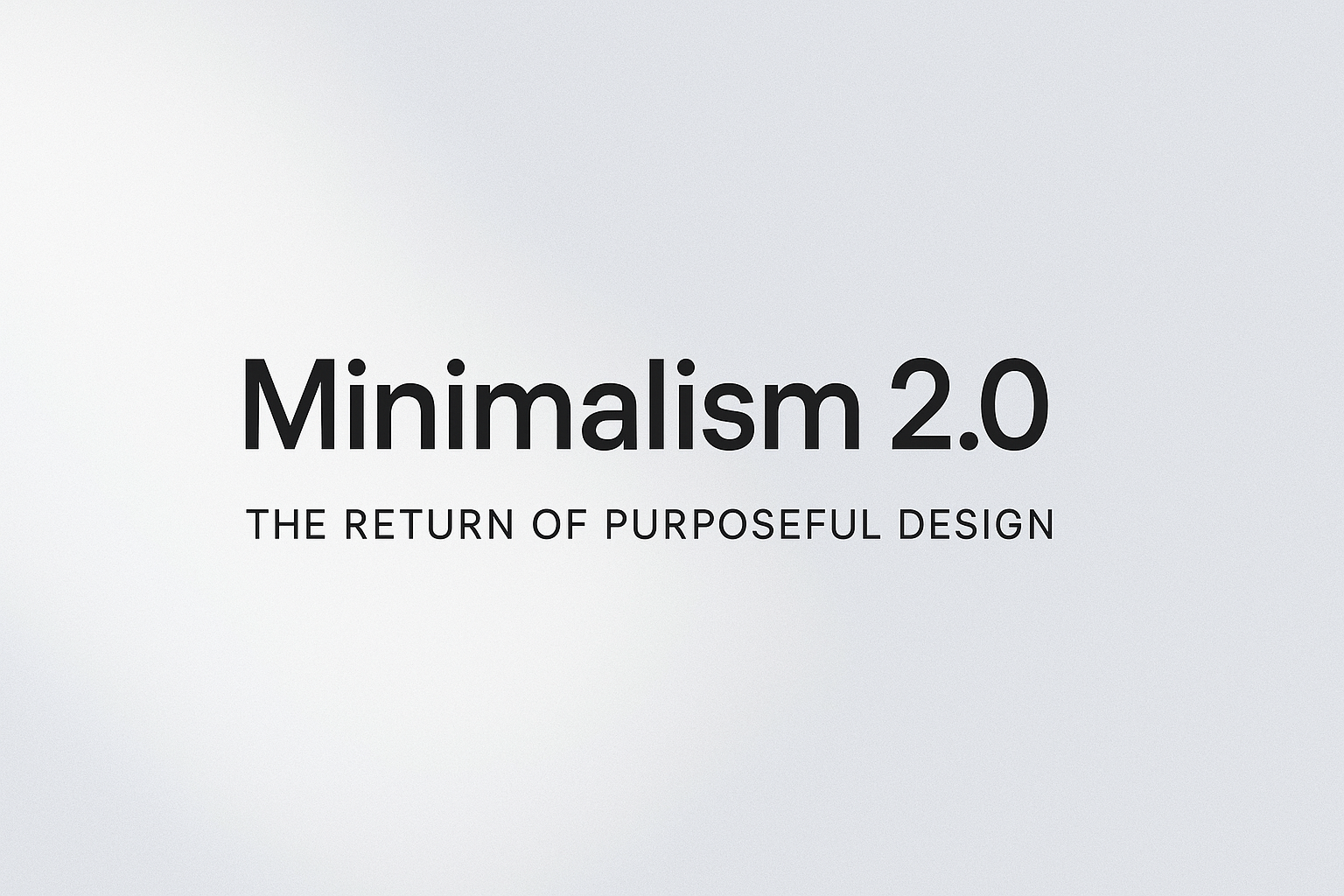
The web is growing fast. As of now, tech is evolving daily, and by 2029, roles in web design & development are projected to grow ~8% — much faster than many other fields. Whether you're more visually creative or technically inclined, there’s space and reward. Here’s a breakdown of what a career looks like, from both Designer and Developer perspectives.
As the internet continues to develop and grow exponentially, jobs related to the industry do too, particularly those that relate to web design and development. The prediction is that by 2029, the job outlook for these two fields will grow by 8%—significantly faster than average. Whether you’re seeking salaried employment or aiming to work in a freelance capacity, a career in web design can offer a variety of employment arrangements, competitive salaries, and opportunities to utilize both technical and creative skill sets.